
Home » Resources » Creative Writing Course » Change in Stories

Change in Stories

Stories are all about change. Let’s review the elements of a story.


A character

enters a new situation,

pursues a goal,

encounters obstacles and struggles,

reaches a resolution

(and changes as a result).

From this definition we see that:

  • The character enters a new situation. Usually near the beginning of a story, some event comes along to upset the status quo. Things are different now and the character needs to adapt.
  • The character pursues a goal. Almost always, the goal is to have or be something different (a promotion, a slain enemy, a treasure, revenge). Even if the character’s goal is to keep things the same (e.g., Woody wants to remain Andy’s favourite toy after Buzz Lightyear arrives), the new situation requires a different strategy than what worked before.
  • Obstacles represent a problem to the character’s goal. As a result they may need to adopt a new approach (plan B).
  • The resolution represents a different state than the one in which the character began. The new state may or may not be in line with the main character’s original goal.
  • The character herself might change as a result of her experiences (character arc).


Change in the Romance Genre

In many ways, Romance stories are very similar from one to the next. They have expected plot elements. For example, almost all Romance stories begin with a couple meeting. Almost all Romance stories end with the couple happily together (happily ever after or happy for now). The major change that occurs in a Romance story is the couple’s evolving relationship.


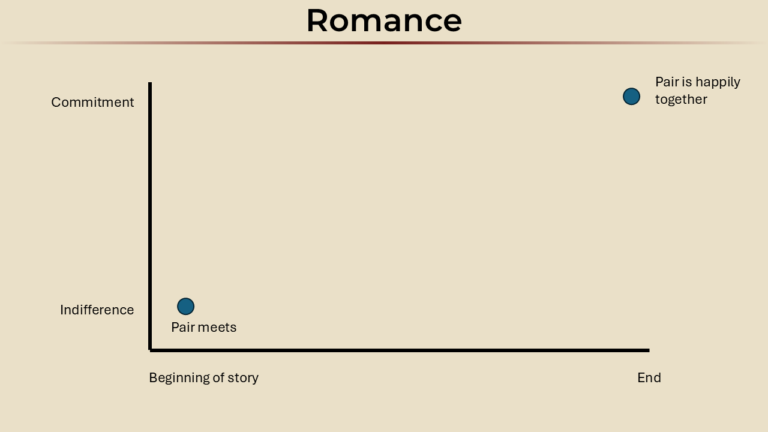
At the beginning, just before the couple first meet, they have no feelings toward each other. They are indifferent. At the end of the story, they are deep in love and often committed to each other. 


If we were to graph this out, it would like as follows.


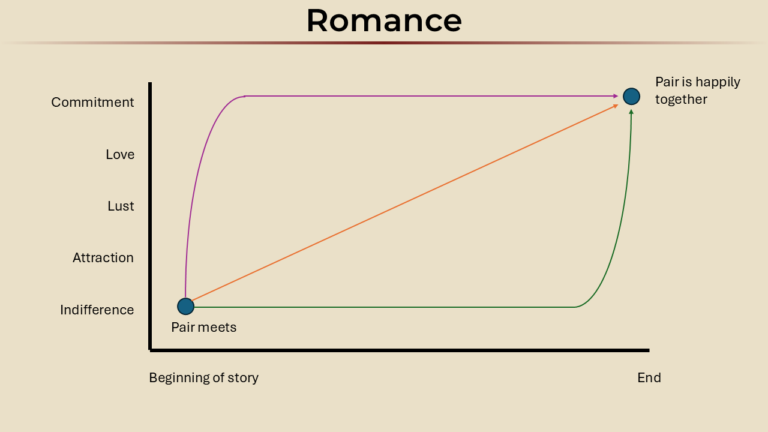
Imagine we can measure how much love exists between the two main characters. We know that just before they meet, they are indifferent and at the end of the story they are deeply in love and committed. But how does their love change over the entire course of the story? As a writer, we have a few options, charted on the graph below:

  • Orange line: a slow and steady growth in the attraction between the two main characters, eventually culminating in love at the end of the story. Predictable and boring.
  • Green line: the feelings between the couple remain indifferent for almost the entire story and then, in a short time, their feelings explode and they quickly become committed to each other.
  • Purple line: the couple fall deep in love upon meeting and that emotion and commitment is sustained for a long period afterwards.

All three of these paths represent a different kind of change from indifference to love, but something about these journeys remains unsatisfying. A slow and steady rapprochement quickly becomes drawn out and predictable. The other two paths demonstrate a rapid rise in love, but also contain very long periods during which the couple’s feelings don’t change. Those long periods risk becoming boring for the reader.


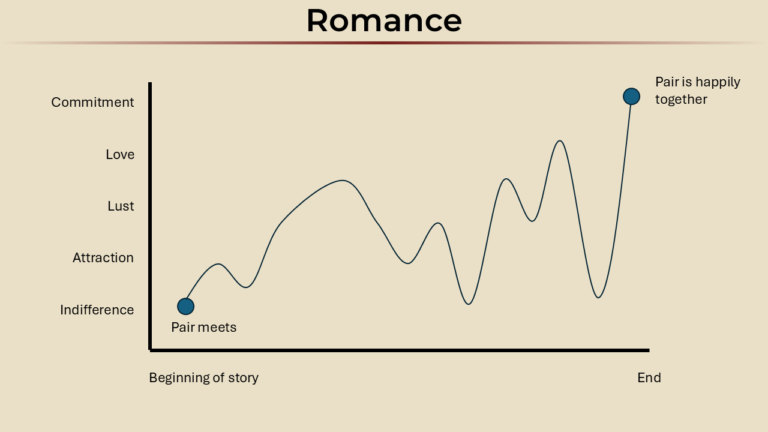
Another approach is shown the the graph, below.

Here, we see a several rapid changes in the couples’ feelings. Their love increases at times, and decreases at other times. The journey looks more like a rollercoaster. The path is unpredictable, keeping reader interest. Also, an occasional setback is more realistic than a relationship that only improves or stays the same.

Value Change

In his book, Story Grid, Shawn Coyne describes a quality of story he calls the “global value.” The global value represents a spectrum of change that occurs in every story. In the case of  a romance, the spectrum of change is indifference to love. In some romances, this spectrum may widen into hate to love.


On the scale of the entire story, there is a major shift along this spectrum. For romance, it’s indifference to love/commitment. However, on the scene level, there is also change that occurs. In fact, Coyne argues that every scene should also contain change along this spectrum.


Change in the Murder Mystery Genre

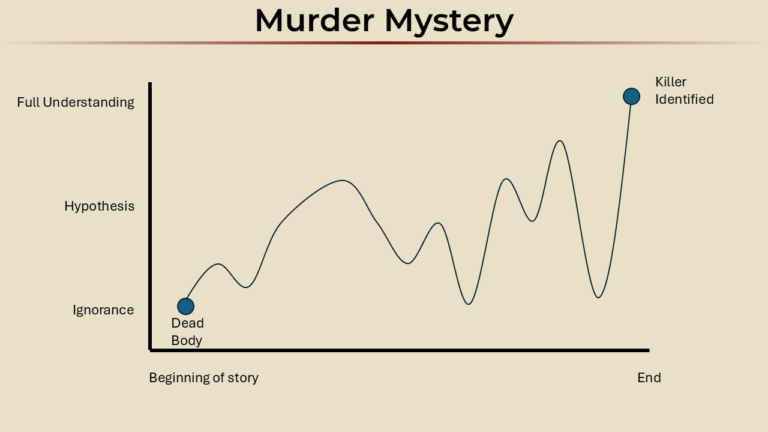
As with a Romance story, a Murder Mystery has certain expected beats. At the beginning, there is a dead body; at the end, the sleuth identifies the killer. 

Whereas a Romance is an emotional story about the heart, a Mystery is an intellectual story. A detective (and the reader) experiences a shift from ignorance to full understanding of the truth.

Similar to a Romance, the Mystery shift is best experienced not as a slow burn of evidence, or as long periods of remaining the same. The shift from ignorance to full understanding is more entertaining when it comes in fits and starts. Real evidence helps advance the case, red herrings and unreliable witnesses cause setbacks.


Change in any Genre

Every genre will have its own value spectrum and every story should have a many changes in this value. Every stories will have one main value at stake, although there may be several lesser ones. Here are some examples:


💖 Love ⇿ Hate 💔
💡 Understanding ⇿ Ignorance 🙈
🌱 Life ⇿ Death 💀
⚖️ Justice ⇿ Injustice⛓️
🏅 Honour ⇿ Dishonour🖤
🏆 Victory ⇿ Defeat🏳️
🕊️ Freedom ⇿ Subjugation🔒
🫱🏽‍ Respect ⇿ Shame 🫣
⚡ Power ⇿ Impotence 🪫
🌟 Success ⇿ Failure 💥
🦉 Wisdom ⇿ Ignorance ❓
🤲 Altrusim ⇿ Selfishness🤑


It’s important to note that not every story goes from one end of the spectrum to the other. For example, in a Survival story, the main character does not go from life to death. Instead, they start the story alive, come close to death, but emerge alive. 


Some values shifts represent internal changes. For example, Scrooge’s shift from selfishness to altruism is a change in attitude in response to the visitations from the ghosts.

RobFitzel.com