
Dan Harmon's Story Circle
The Three Act Structure and the Seven Point Story Structure represent a linear sequence of events. The protagonist begins in one place and pursues a goal to get them somewhere else.
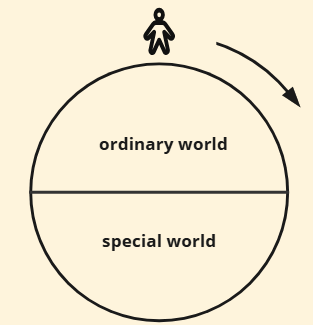
Other stories are circular. The main character begins in a certain place, they go off on an adventure and then they return to their starting point. The most famous circular story structure is Joseph Campbell’s Hero’s Journey. The Hero’s Journey describes a sequence of events of an epic adventure. An ordinary person starts in their ordinary world, leaving the familiar behind as they travel to a distant, exotic land known as the special world. There, they make allies and enemies, endure tests and ordeals, and return back home, bringing a treasure or wisdom back to the tribe. Campbell’s model has around 20 different steps (depending on the specific version). This complexity has led many to seek a simpler model. Dan Harmon’s Story Circle is such a model.
Dan Harmon is best known for co-creating Rick and Morty and producing Community. He wrote for both shows and developed the Story Circle (sometimes called Story Embryo) to write episodes of those TV shows. His model is a simplified version of the Hero’s Journey and tends to be more character-centric.
Harmon wrote a fascinating series of articles that describes some of the foundations of this model.
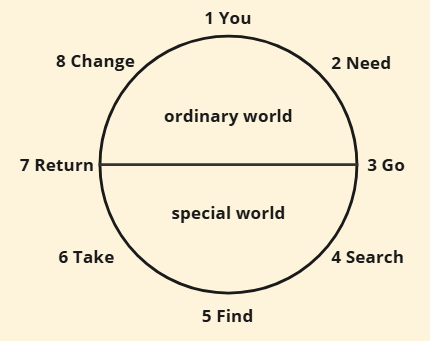
There are 8 steps to the Story Circle. Although they are drawn equally-spaced around the circle, they don’t need to occupy the same duration in the story.

1. You
The Story Circle is character-centric, meaning that it focusses on what’s happening to the protagonist throughout the story. Step 1 establishes the main character in their comfort zone – a familiar, albeit not perfect environment.

2. Need
The character has a need, a desire, or a goal. This intent could be an internal want expressing itself or it could be a reaction to an external event, like the inciting incident.

3. Go
The character needs to leave their comfort zone in order to pursue their goal. They travel to the special world.

4. Search
In the special world, the character searches for what they need. The rules in the special world are different. The tools and strategies the character would normally use don’t work here. Consequently, the character struggles to adapt to their new surroundings.

5. Find
The character finds something. Sometimes, they find exactly what they were looking for. More often, they find something different, something unexpected, or something even better than their goal. In this step, the character is at their most vulnerable and they often learn something important about themselves. This self-discovery is often the real lesson of the story.

6. Take
The character takes something from the special world. This item may be a literal treasure or object, or it may be something learned. In either case, taking something from the special world always comes with a heavy price. Characters often sacrifice something at this step so that they can take what they want. This is a great place for characters to struggle with a dilemma.

7. Return
The character journeys home, toward the familiar. The ordinary and special worlds are separated by a threshold, a barrier that takes effort to cross.

8. Changed
The character returns home, having changed. They may bring back the treasure to their tribe, but more often they come back different, perhaps wiser from their adventures in the special world.
Worksheet
Here is an online worksheet to help you develop your own story using the Story Circle.
 Story Circle Worksheet