
Seven Point Story Structure
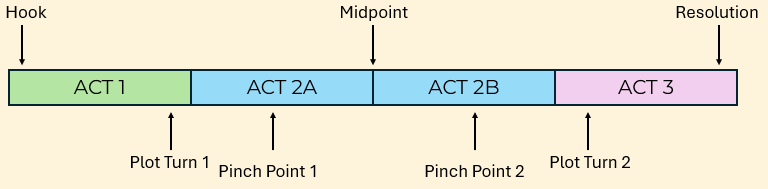
The Seven Point Story Structure was invented by Dan Wells, inspired by the Star Trek Role Playing Game Narrator’s Guide. His approach is not only a structure, but also an approach for outlining a story. While it doesn’t depend on three acts, I think it works well as a “more complicated” three act structure.
Attention Screenwriters: these seven points are expected at certain percentages along the course of a movie. For non-screenplays, I think there’s a lot of latitude for when these events can take place (although I think they line up well with a three act structure).
Start at the Resolution
Wells suggests starting the development of a story idea at the end. Knowing where your story ends allows you to steer it in a certain direction. Also, knowing the ending (a happy ending vs. a tragic ending) sets a tone for the rest of the story and permits for some foreshadowing along the way.
Jump to the Hook
With the ending in mind, Wells suggests to develop the story beginning, which he calls the Hook. The Hook is different from the oft-heard writerly advice about “hooking” the reader with a compelling introduction.
In the Seven Point Story Structure, the Hook refers to the beginning state of a character or situation. The Hook is simply the opposite of what happens at the end of the story. For example, at the end of Star Wars: A New Hope, Luke Skywalker is a brave, galactic hero. At the beginning, he is a whiny farm boy.
By making the beginning and end of the story very different, if sets up change across the story.
The Midpoint
Like in the three act structure, the Midpoint represents a turning point in the middle of the story. This turning point often injects badly needed energy in an otherwise saggy middle.
The Midpoint can take many forms, and it can take place over multiple scenes.
A Midpoint might be:
- New information that allows the protagonist to take action.
- A False Victory that appears to close the door on the story, only for the truth to open another door.
- A twist, like in a murder mystery when a second murder is discovered. The investigation now widens.
- A reframing of what happened before. In the first half of Gone Girl, all of the evidence points to Nick having murdered his wife. At the Midpoint, the reader learns she’s alive and is trying to frame her husband for the murder. The victim and villain reverse roles.
- The beginning of change in the main character. For example in the Midpoint of Star Wars: A New Hope, Luke learns that Princess Leia is a hostage and that she is to be executed. Luke (who’s been passive and reactive until that point), begins to draw his inner strength and convinces his allies that they should rescue her. Luke’s courage increases over the story, allowing to play a more active and heroic role.
Plot Turn 1
The remainder of the Seven Point Story Structure is comprised of a symmetrical arrangement of important events.
If we were to overlay the Seven Points on top of the Three Act Structure, Plot Turn 1 (sometimes called Plot Point 1) takes place at the transition between Act 1 and Act 2.
In Plot Turn 1, our protagonist leaves their ordinary world behind, carrying their new goal. This step marks a point of no return as our character steps into the arena of the conflict to come.
Pinch Point 1
A Pinch Point is an event (or series of events) that applies pressure to the protagonist. The antagonist attacks, a play goes awry, etc.
The antagonist is often introduced at Pinch Point 1 and they demonstrate their power.
Pinch Point 2
At Pinch Point 2, the antagonist attacks. While late in the story, this point reminds the reader that the antagonist remains powerful. Often their attack is so successful that all hope is lost for the protagonist.
Falling at the end of Act 2, this setback raises suspense for the next Act.
Plot Turn 2
Plot Turn 2 (sometimes called Plot Point 3), is the protagonist’s final push against their adversary. The outcome looks bleak. The odds are stacked against them. And yet, our hero bravely fight back. At this point, the character often finds the missing puzzle piece they need to win. (This piece is often mentioned or foreshadowed in the first part of Act 2). For example, Luke Skywalker uses the Force, which he first started learning about with Obi Wan earlier in the story. James Bond often defeats his nemesis using one of his gadgets acquired early in Act 2. Sometimes our hero simple remembers to believe in themselves to eke out a victory.
The journey from the despair of Pinch Point 2 to the victory in the final Resolution is a large change in momentum, one full of conflict and hope. This swing engages the reader’s emotions as they root for the hero in their final battle.
Worksheet
Here is an online worksheet to help you develop your own story using the Seven Point Story Structure.
 Seven Point Story Structure Worksheet